


SOUNDING AND WEATHER ROCKETS FACT SHEET
By Cliff Lethbridge
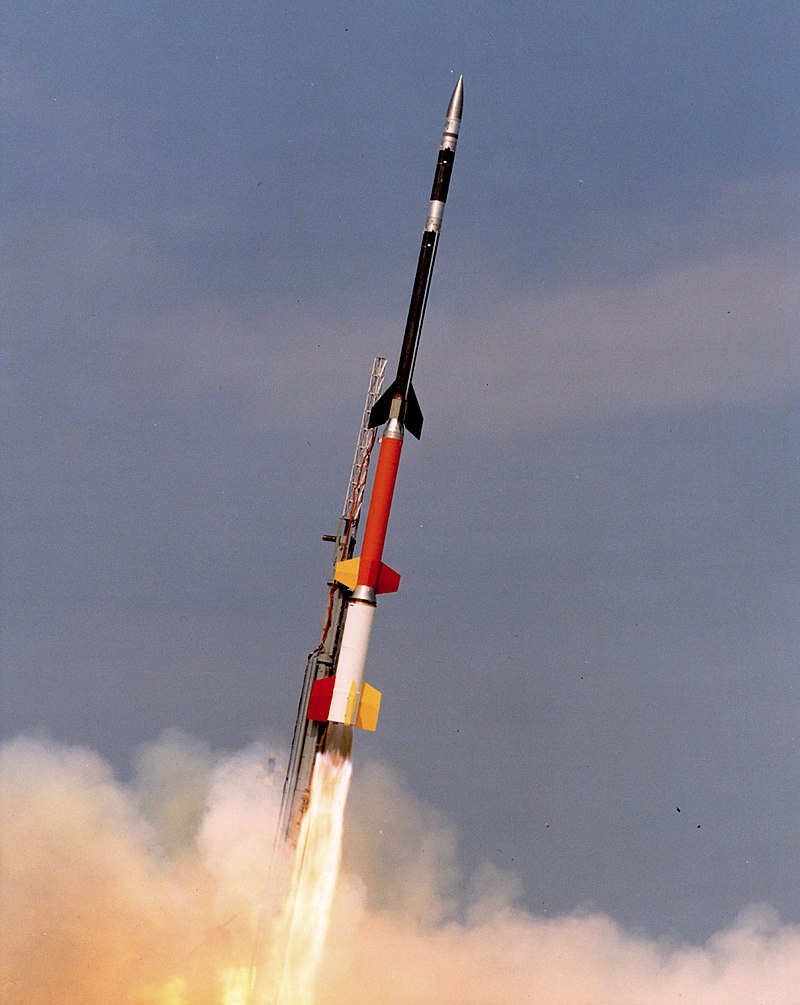
Sounding Rocket Launch, Photo Courtesy NASA
Although the least known and most underpublicized of rockets, sounding and weather rockets represent the greatest number and frequency of Cape Canaveral launches. Because they are numerous enough to be considered routine, with only a few exceptions, sounding and weather rockets are not included in official Cape Canaveral launch chronologies. In point of fact, weather rockets are a specific type of sounding rocket. Sounding rockets are designed to carry instrumentation to record data high in the atmosphere, or carry small scientific payloads to high altitude. The flight path of a sounding rocket is fairly simple. Usually launched from a fixed rail launcher, the sounding rocket is launched to a vertical flight path. After it reaches its intended altitude, the sounding rocket enters a parabolic glide, then falls back to Earth. Sounding rockets typically have a range of 10 to 500 miles in altitude. Sounding rockets are solid-fueled, and may employ one to six stages.
In the case of weather rockets, the nosecone of the rocket carries an instrumented payload capable of telemetering high-altitude weather data, including wind velocity and direction, to ground stations. The weather rocket can be a valuable source of data prior to a space launch vehicle or Space Shuttle launch. In some cases, several weather rockets may be launched prior to a space launch. This is to assure that conditions aloft will not adversely affect the vehicle in flight. Weather rockets offer a considerable advantage over weather balloons, in that they can operate more quickly and at higher altitudes.
Many of the sounding rockets launched from Cape Canaveral are for research rather than weather purposes. In these applications, the sounding rocket carries an instrumented payload which is designed to reach high altitudes, possibly for a brief period of weightlessness as the rocket glides and then returns toward Earth. In some instances, the payload separates from the rocket and is recovered at sea. Because sounding rockets are relatively small and simple, they can be launched frequently and at a relatively low cost. No records are kept as to how many sounding rockets have been launched from Cape Canaveral, but the number is likely in the thousands.